

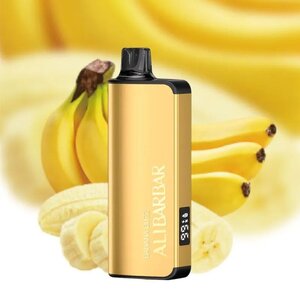
Yes. Alibarbar‘s official website displays a warning that its vape products contain nicotine and that nicotine is addictive. That answers the broad question, but it does not tell you the exact nicotine concentration in a particular device. It also does not prove that a unit was lawfully supplied in Australia.
For an Australian reader, those are three separate checks: nicotine presence, nicotine strength and lawful supply. Treating them as the same thing is where many online answers become misleading.
What the manufacturer actually confirms
The official Alibarbar pages for the Ingot range display a nicotine warning. This is stronger evidence than an anonymous marketplace listing or a reseller FAQ because it comes from the brand’s own website.
However, the public pages reviewed for this article did not provide a reliable concentration figure that could be applied to every Alibarbar model, market or batch. A product name, flavour, puff count or device colour is not a nicotine-strength measurement.
If a listing claims a percentage or an mg/mL value, look for documentation tied to the exact unit. Do not assume that a number copied from an overseas seller applies to a product in Australia.
Use four separate checks, not one
| Question | What can answer it | What does not prove it |
|---|---|---|
| Does the brand say the product contains nicotine? | The manufacturer’s current warning | A reseller’s description alone |
| What is the exact concentration? | Unit-specific, lawful supply documentation and compliant labelling | Brand name, puff count, flavour or package colour |
| Is the unit authentic? | A valid manufacturer verification process plus consistent packaging and batch details | A QR code by itself |
| Was it lawfully supplied in Australia? | The Australian therapeutic-vape pharmacy pathway and applicable TGA requirements | Authenticity, an overseas listing or a local-looking website |
This evidence ladder matters because a genuine overseas product can still fall outside Australia’s lawful supply pathway. Conversely, a package that looks convincing can still contain inaccurate or incomplete information.
Why exact nicotine strength should not be guessed
Nicotine strength may be expressed as a percentage or in milligrams per millilitre. Those units can be compared only when the underlying label is reliable and refers to the liquid concentration. They should not be reverse-engineered from a claimed number of puffs.
Our separate Australian nicotine-strength guide explains how common units are read and why a label still needs a trustworthy source. The key point for Alibarbar products is simple: the official warning supports the conclusion that nicotine is present, but it does not justify inventing a universal strength.
What Australian law changes about the answer
Australian Government guidance states that all vapes, whether or not they contain nicotine, are regulated as therapeutic goods. They may only be supplied through participating pharmacies for smoking cessation or the management of nicotine dependence. Other retailers, including vape shops and convenience stores, cannot lawfully sell vapes.
That means a question such as “does this vape contain nicotine?” is only one part of the Australian decision. You also need to know whether the product meets the applicable therapeutic-vape requirements and was supplied through the lawful pathway.
For the wider framework, see our guide to current vaping rules in Australia. Government guidance should always take priority over a retailer’s summary.
Does an authenticity code prove the contents?
No. Alibarbar provides an official product-verification service and a process for reporting suspected counterfeits. Those tools can be useful when checking whether packaging details match the manufacturer’s records.
They do not independently test the liquid inside a device. They also do not establish that the product complies with Australian therapeutic-goods rules or that it entered the Australian supply chain lawfully.
Follow the manufacturer’s current verification instructions and compare the result with the model and package details in front of you. A screenshot supplied by a seller is not the same as checking through the official route yourself.
A practical label-check sequence
- Identify the exact model. Do not transfer specifications from a different Ingot, Pandora or Swirl product.
- Read the physical package and accompanying information. Look for a clear ingredient or nicotine statement rather than a vague “strength” claim.
- Check the source of the number. A seller’s copied specification is weaker than lawful, unit-specific documentation.
- Verify authenticity separately. Use the manufacturer’s own website, typed directly into your browser.
- Check the Australian supply pathway. Authenticity is not a substitute for pharmacy supply and TGA requirements.
What to do if nicotine exposure is suspected
For suspected nicotine poisoning in Australia, call the Poisons Information Centre on 13 11 26. Call 000 for severe symptoms or an emergency.
The short answer
Alibarbar’s official website says its vape products contain nicotine. Do not turn that warning into an assumed percentage, and do not treat a genuine-product check as proof of lawful Australian supply. For a reliable answer about a particular unit, the exact model, compliant documentation and Australian pharmacy pathway all matter.





Leave a comment